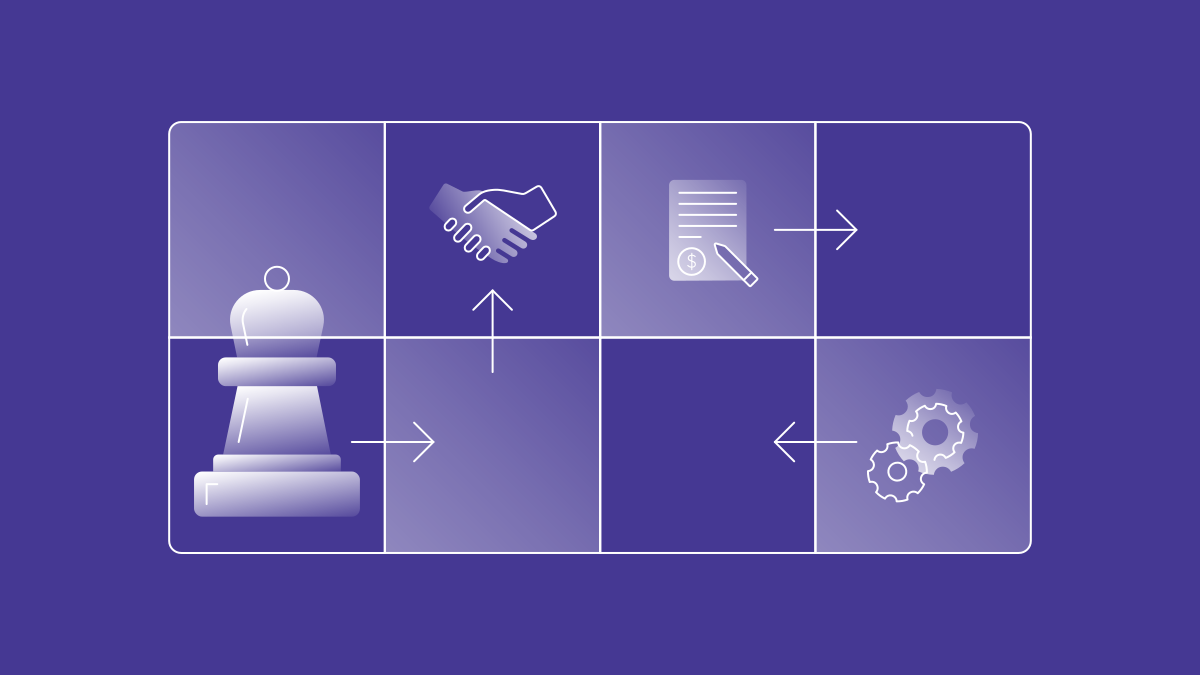
Value Realization: a strategic discipline across the customer lifecycle
B2B buyer expectations have evolved. With shrinking budgets, tighter competition, and the constant information overload, buyers want to see a product’s value — quantified in real, hard data. Value Selling is becoming the new demo of B2B sales, and a powerful tool to push stalled deals forward. But the ROI story doesn’t end there — just as the need for quantifiable proof doesn’t end at the point of sale. Enter Value Realization: together with Value Selling, it’s a continuous, cross-functional discipline that begins before the deal is closed and extends long after. This approach engages stakeholders across the organization — sales, customer success, product, finance, and beyond — transforming what was once the domain of traditional value engineering into a shared, data-driven responsibility. From one-time ROI pitch to continuous value strategy Historically, “value selling” was often confined to justifying a purchase during the sales cycle. Today, however, executives and customer success leaders recognize that value realization must extend beyond the initial to and quantify potential value in pre-sales and realized value post-sales – to support marketing, selling, retention and expansion efforts. In other words, value is no longer a one-off ROI calculator handed over at contract time; it’s an ongoing strategy that underpins the entire customer lifecycle. This strategic approach aligns all go-to-market teams – marketing, sales, product, and customer success – around delivering outcomes that matter to the customer. By making value a continuous narrative, organizations build stakeholder confidence and long-term partnerships instead of just closing one-time deals – ensuring stickiness and reducing churn. Industry research reinforces why this shift is urgent. According to Forrester, almost 9 in 10 B2B purchases stall during the buying journey, and when a decision is made, more than 80% of buyers are dissatisfied with their chosen provider.This value gap leads many buyers to stick with the status quo out of fear – or to choose a competitor who does quantify clear outcomes. The message is clear: quantifying business value is no longer a nice-to-have, but a must-have capability across the buyer’s journey. Pre-purchase: quantifying ROI to win confident buyers Before a deal is won, sellers need to prove why the investment is worth it. Building a compelling ROI/TCO business case is now often the deciding factor in B2B purchases – even more influential than demos or trials. Buyers overwhelmingly expect vendors to quantify value and provide formal business-case content during their evaluation. Interactive ROI and TCO calculators and business value assessment tools make the financial case clear. Instead of static spreadsheets, sellers can collaborate with prospects on dynamic models tailored to the buyer’s specific pain points and KPIs. This approach not only produces hard numbers (e.g. projected cost savings or revenue gains), but also instills confidence by showing exactly how the solution maps to the customer’s business objectives. Self-service configuration and alignment with CRM or data sources ensures that sellers, marketers, and revenue teams work from a single source of truth. This enables consistent value messaging from the first touch through the final proposal – and a much greater likelihood of getting that critical “Yes” from the buying committee. Post-purchase: delivering and measuring realized value Winning the deal is only the beginning; the real work for customer success teams starts with delivering on the promises made. Value realization means tracking whether the customer actually obtains the business outcomes that justified their purchase. Customer Success (CS) managers can use realized value assessments – essentially, value calculators applied to the customer’s live data – to measure the before-and-after impact of the solution. By comparing baseline metrics (e.g. cost, efficiency, revenue) from pre-implementation to post-implementation results, the CS team provides concrete evidence of the ROI achieved. Crucially, this quantification is not a one-time exercise but an ongoing practice. A SaaS customer’s business environment is always evolving, so teams need to continuously update value calculations with new data and insights. For example, a CS leader might demonstrate, “6 months in, you’ve realized X dollars in savings and Y hours freed up – which is 85% of what we projected in the business case. Here’s how we’ll close the gap to 100%.” This turns customer success managers into value coaches who actively ensure customers get maximum benefit. It also changes the tone of customer engagements: instead of reactive support, CS conversations become strategic reviews focused on outcomes and optimizations. Why does this matter? Because if customers don’t perceive the value they were promised, they won’t stick around for long. As one industry guide bluntly puts it, “If your customers don’t perceive the value they’re getting from your product, why wouldn’t they cancel their subscriptions and move to a competitor?” Regularly validating and communicating realized value is essential for customer retention. It reinforces that the product is delivering the expected impact (or illuminates where it isn’t, prompting corrective action). This proof of value not only secures the renewal, but often creates internal champions who advocate for your solution. In fact, companies that excel in value realization treat it as a core part of customer success strategy, using data to monitor customer health and trigger proactive outreach when value metrics slip. The end goal is a loyal customer who sees your product as integral to their success – and has the numbers to back it up. Renewal and expansion: fueling growth with ongoing value When it comes time for renewal or expansion discussions, a strong foundation of proven value changes the game. Instead of tense negotiations, these conversations become positive dialogues about future opportunities. Value analytics dashboards that pull together all the data from pre-sale value cases and post-sale value tracking give a holistic view of the account’s journey. Both the vendor and customer can clearly see how far the customer has come (e.g. “You achieved 120% of your ROI target this year”) and identify new areas where additional value can be unlocked. This insight supports upsell and cross-sell initiatives: you can point to concrete success in one area as justification to expand into another. It also facilitates a “land and expand” approach – delivering quick wins initially and then scaling usage as new use cases prove out. Leading companies are using this approach to drive remarkable growth. For example, Databricks (a high-growth data platform provider) institutionalized value realization to tie their solution to customers’ specific outcomes at every stage. Because Databricks’ pricing is consumption-based, “the more customers use it, the more they spend” – so the ability to continually articulate value was critical to funding new use cases and expansions. By embedding value realization into their go-to-market approach, Databricks saw high adoption (80% of their reps) and win rates jump from 8% to 55% when value discussions were involved – a 587% increase in win-rate. That kind of impact extends beyond initial sales: those quantified success stories make renewals almost a foregone conclusion and give executives confidence to green-light broader deployments. Other innovative organizations like Okta, ADP, and Hexagon have similarly embraced full-lifecycle value management to strengthen customer relationships and expansion outcomes. The bottom line: making value realization a competitive advantage The shift from ad-hoc value selling to an integrated value realization discipline is changing the way companies engage customers. It elevates the conversation from features and price to business impact and outcomes – the language that resonates with C-suites and secures long-term partnerships. Customer alignment starts with tools that connect customer challenges to solutions and services, glued together by ROI. Organizations that quantify ROI up front, validate success over time, and share insights across teams can scale this practice across all their go-to-market functions. The payoff is measurable: fewer stalled deals, higher win rates, more renewals, and bigger expansions. Perhaps most importantly, it builds trust. When a vendor becomes a true value partner – continually holding themselves accountable for delivering results – they earn a level of customer loyalty that competitors can’t easily disrupt. Value realization turns customers into advocates. In summary, value realization is emerging as a strategic imperative for modern revenue leaders, having come a long way from being a mere sales tool – even if a valuable one. Those who operationalize it across the customer lifecycle are seeing tangible improvements in revenue performance and customer satisfaction. As you plan your next move in revenue enablement or customer success, ask yourself: How are we proving our value, every step of the way? If the answer isn’t clear, it’s time to invest in the tools and discipline that make value realization an everyday practice. Ready to turn value realization into your competitive advantage? Learn more about the Mediafly Value tools to see how you can start quantifying and delivering value at every stage of the customer journey.
Integrated vs. purpose-built applications: what’s the real difference?
One of the most common questions I get is, what is the difference between an integrated application and one that’s purpose-built to work within the fabric of another platform, like a CRM, ERP or other sales operating system? While both approaches aim to connect systems and streamline workflows, the depth of connection, user experience, and long-term value can differ dramatically. Simplicity for users and the greatest organizational value can be achieved by choosing purpose-built apps natively woven into core CRM platforms. With Mediafly for SAP Sales and Service Clouds, users work directly within SAP, increasing adoption by as much as 300%. Integration: more than just an iframe Integration is often misunderstood as simply embedding one app into another. Think of an iframe that displays a web page from a different application inside your main platform. This technique can create the illusion of a unified system, but often only offers a surface-level, one-way connection. The user interface might look seamless—it may even work in context of where the user is—but the underlying systems aren’t truly integrated to drive value for the user, who is the one the application is supposed to serve. There are ways to deepen this integration. A more valuable approach is contextual integration, where the embedded application dynamically interacts with the hosting platform. If the embedded application can leverage and exchange data from the host platform, such as passing customer data or user preferences into the iframe, the value to the end user increases, including improving the user experience. But the most robust integrations go even further, enabling backend interactions. When the hosted application exchanges data through the application layer or data layer, performing lookups or writing back information (and some apps do this automatically, without user intervention), true, deep integration is achieved, approaching the functionality of a purpose-built solution and delivering a truly unified and powerful experience. SSO: a step, but not the destination Single Sign-On (SSO) is another integration milestone that is often misunderstood. SSO allows users to log in once and access multiple applications. This is great for security and management. However, from the end-user’s perspective, SSO alone does not mean the applications are genuinely working together to provide value. It just means fewer passwords to remember. True interoperability is about more than just access; it’s about delivering real connection and thus, value, through shared processes and data. What to look for: ‘integrated’ vs. purpose-built apps When evaluating solutions, consider these three key criteria: Sales teams typically rely on their CRM (SAP, Salesforce, Hubspot), Gmail or Outlook email client, or other core tools in varying measures. The best applications for these users are purpose-built to integrate natively within the primary platform being used, minimizing the need to force users to navigate between disconnected systems. That reduces friction in their daily workflows to enhance productivity. A purpose-built application should offer a quick, straightforward setup and ongoing compatibility with future platform updates. This not only saves time for IT, sales operations and marketing, but also lowers the total cost of ownership. Vendors that invest in deep integration and ongoing certification ensure their app continues to work with the latest platform releases. This requires the vendor to continuously test and optimize, giving users confidence the app’s performance won’t be left behind as the main system evolves. Look for official certifications or endorsements from your primary platform provider (like your CRM or sales platform provider). This signals that both vendors are strategically aligned, working together to solve your business challenges and provide reliable troubleshooting and support when you need it. Without certification or endorsement, the situation can be very different. An app could simply be writing to an API, meaning it could be working on a trial-and-error basis or only for a short period before breaking or becoming unstable over its lifetime of intended use. Case in point: sales enablement apps Many sales enablement vendors claim seamless integration with CRM systems like SAP Sales and Service Clouds, but few other than Mediafly, SAP’s only Endorsed App for sales enablement, truly work that way right out of the box. “App buyers should demand one user experience for their sales and service teams, rather than a separate dashboard or Home screen to log into.” Companies often purchase enablement believing it is integrated, only to find users still must work on separate platforms. Either the company decides to leave the disconnection in place, or it must take the time and effort to complete further integration steps. That can be frustrating, especially considering varying stakeholders’ interests (IT in particular!) App buyers may not realize that they should demand one user experience for their sales and service teams, rather than a standalone app, or another “dashboard” or “Home screen” that a user needs to log in and monitor. With a purpose-built, fully integrated app like Mediafly, users access the app directly through their SAP CRM. That greatly simplifies life for sales teams and based on our experience with enterprise companies, increases CRM adoption substantially. Full integration also means that companies can deploy Mediafly far faster than other enablement apps, in weeks rather than months, achieving faster time to value and fewer IT headaches. With the availability of version 2 for SAP Sales and Service Clouds, many organizations are working to migrate their data. Mediafly bridges the gap between versions so workflows can remain uninterrupted. Some of the ways Mediafly enhances seller execution: “For sales teams, time is of the essence. Reps that used to spend hours researching the right content can reduce that to a few seconds, and emails can be drafted in minutes,” notes Sebastine Augustine, VP, Head of Product Management, SAP Sales Cloud. “With every engagement tracked and reported within SAP, including pipeline attributable to the content shared, sellers are empowered to create deeper customer connections. Using Mediafly on SAP really does create opportunities for improved sales effectiveness, leading to increased sales,” he said. The bottom line Integrations—whether custom-built or pre-packaged—can connect your systems and automate processes. But to maximize value, reduce IT friction, and ensure rapid adoption, purpose-built applications that are natively woven into your core platforms are often the best choice. The goal is to bring applications together with existing platforms to provide value to the individual user. When that is accomplished, they can do their jobs more effectively and in turn, drive greater value for shareholders. So, choose apps that meet your users where they work. Do this by delivering capabilities in a seamless, intuitive fashion, and you’ll drive both value and adoption across your organization. In the end, it’s not just about connecting systems, it’s about creating an environment where your teams can thrive, innovate, and deliver results. Frustrated by integration issues with your current content, sales support or coaching apps? Find out how our purpose-built, SAP Endorsed sales enablement app can help you achieve your revenue and CX goals inquire here. Get a customized analysis of what Mediafly can achieve based on your sales challenges. Learn more and sign up for your free report here.
7 steps to make sales enablement content successful
Think about when your top sales rep closed that complex deal against all expectations. Yes, that time. What set them apart wasn’t just their skill. If you’re reading this line, you well know that having the right sales enablement content at the right time made the difference. Seasoned enablement professionals like you understand that content isn’t merely supportive materials—it’s a strategic asset and way of working that closes deals. It equips your sales teams to engage buyers effectively and adapt to changing behaviors. Our K.I.S.S. breakdown of sales enablement content Sales enablement content encompasses a range of materials designed to support the sales process. At Mediafly, we break it down into internal and external. In a nutshell: internal sales content enablement for your sellers, and external content, for buyers. Let’s delve into them: Sales Enablement Content Internal External Overview Resources that enhance the sales team’s knowledge and skills. These materials help sales professionals navigate intricate sales cycles and address sophisticated buyer objections. Assets shared with buyers to facilitate their decision-making process. This content is crafted to resonate with informed buyers who have high expectations and specific needs. Examples Detailed competitive analysis, advanced product training modules, playbooks tailored to complex sales scenarios, and insights into buyer psychology. Customized proposals, in-depth case studies demonstrating ROI, industry-specific whitepapers, and interactive product demonstrations. We like to K.I.S.S. 👄 Why You’re Having a Hard Time Articulating the Importance of Sales Enablement Content You might be finding it hard to get others in your org to grasp the critical role of sales enablement content. Even though you know that strategic content empowers your sales team and helps drive revenue, others may see it as optional. It’s frustrating, I know it, especially when you can’t show immediate results or clear metrics to back up your efforts. 3 Arguments That Contextualize Our Recommendations For seasoned professionals, the value of sales enablement content extends beyond basic content support because: Our 7 top recommendations to maximize sales success 1. Implement a Human-Centric Approach to Sales Enablement Content Creating effective sales enablement content requires a dual focus on the buyer and the sales team, so… To truly support your sales team, immerse yourself in their daily routines. This is what our sales enablement champs that work for customer organizations do: By aligning content delivery with their workflows, you increase adoption and effectiveness. And 2. Help personalize content for buyers Buyers expect interactions that reflect their specific situations. With that in mind, I’ve asked a number of sales enablement admins from Mediafly customers and this is what they do: By enabling reps to provide personalized experiences, you help enhance engagement and that makes deals to progress.. 2. Curate Content to Prevent Sales Content Overload Most sales enablement professionals agree that more content isn’t always better. To avoid overwhelming sales reps, here’s the top 3 things to do: A multinational corporation in the food and beverage space found that its sales reps were struggling to find relevant content amid an overwhelming number of resources. By implementing a centralized content management system with AI-driven search, they reduced content retrieval time by 40%. Sales reps could quickly access localized materials tailored to their region, leading to increased adoption and improved sales performance. 3. Leverage AI and AI-Analytics in Sales Enablement You’ve heard it left and right. AI puts at our hands opportunities to improve the effectiveness of your sales enablement content. Here’s two ways we’re currently using at Mediafly: 4. Collaborate Cross-Functionally Creating impactful sales enablement content requires input from various departments. This pertains to the “internal” group I mentioned above.: A lesson about rituals: A financial services firm established regular workshops between sales, marketing, and product teams. This cross-functional collaboration led to the creation of targeted content that addressed emerging market trends. Sales reps reported higher confidence in conversations with prospects, and the company saw a measurable increase in customer acquisition. 5. Embrace Continuous Learning and Ongoing Training In a rapidly changing market, ongoing training is essential. You don’t want to just meet with sales to ask or gather their requests. You want to educate them on how, when to use your materials and processes in the best way. That’s why you want to put these into practice… yesterday! 6. Align Content with the Evolved Buyer Journey Recognize that buyers control much of the sales process nowadays it’s a no brainer. We recommend you address this through: 7. Measuring the Impact of Sales Enablement Content Quantifying the effectiveness of your content is crucial and will help you in your curation and further production. That’s why you want to: A tech company noticed that despite having a vast library of content, certain assets were rarely used. By analyzing content engagement metrics, they identified which materials were most effective at progressing deals. They shifted their focus to producing more of these high-impact assets, resulting in a 15% increase in closed deals over six months. Because it’s not just about the what (sales content), but the how (the enablement). For experienced sales enablement professionals like, the challenge is not just creating content but ensuring it strategically empowers sales teams and aligns with buyer expectations. By adopting a human-centric approach, curating content thoughtfully, leveraging technology, fostering collaboration, committing to continuous learning, aligning with modern buyer journeys, and rigorously measuring impact, organizations can maximize the effectiveness of their sales enablement content.
Breaking down the Value Enablement lifecycle
Remember when a strong sales pitch and competitive pricing were enough to win deals? Today’s buyers are demanding something different. They’re more informed, more selective, and have higher expectations than ever before. They’re not just looking for products or services — they’re seeking proven, quantifiable value at every stage of their journey. This shift has fundamentally changed how successful companies approach sales and customer relationships. According to ValueSelling Associates, 87% of high-growth companies now take a value-based approach to sales, recognizing that traditional feature-based selling is no longer enough. Revenue teams must now communicate, quantify, and prove value at every touchpoint — whether it’s a new opportunity, a renewal discussion, or an expansion conversation. Enter value enablement: a systematic approach that empowers organizations to do just that. In this guide we’ll break down the value enablement lifecycle, helping you to understand how to incorporate value across every stage and exploring how different teams can work together to drive growth, increase customer satisfaction, and build lasting partnerships. Understanding the value enablement lifecycle 1. Value defined Defining and articulating your value proposition forms the foundation for effective marketing and sales strategies. This stage focuses on crafting a compelling value story that resonates with every member of your audience. A value story is the cornerstone of effective marketing. It goes beyond simply listing product features — instead identifying your buyer’s unique challenges and quantifying how your solution will address them using real data. This approach creates a narrative that not only captures attention but also demonstrates a deep understanding of your customers’ needs. To formulate a value proposition with clarity and impact, Mediafly’s CLOSE methodology combines the right balance of emotion, rationale and evidence. Let’s break it down: This approach enables marketing teams to build credibility and trust while ensuring messages are aligned with customer needs. 2. Value ignited Once you’ve defined your value proposition, the next step is to ignite that value in your marketing efforts. This stage focuses on driving more qualified leads and engaging prospects earlier in their buying journey. According to Gartner, only 17% of the buyer journey is spent meeting with potential suppliers. This means that by the time a prospect engages with a sales rep, they’re well over halfway to making a purchase decision. Marketers play a critical role in shaping this early part of the buyer’s journey. To capitalize on this shift, use self-service marketing tools to introduce your unique value proposition earlier in the sales cycle. Here are some tools to consider: Diagnostic Assessments Diagnostic assessments are interactive tools that help potential customers identify their pain points and understand how your solution can address their specific challenges. When implemented on your website, these can: ROI Calculators ROI calculators allow prospects to input their own data and see the potential return on investment they could achieve with your solution. These tools: Interactive Product Demos Self-guided product demos give prospects a hands-on experience with your solution without requiring direct interaction with a sales representative. These demos: Value Benchmark Tools These tools allow prospects to compare their current performance or processes against industry standards or best practices, and: Chatbots and Virtual Assistants Implement AI-powered chatbots that can answer basic questions, provide resources, and even schedule meetings with sales reps. These tools improve customer experiences by: By implementing these tools, you’re not passively waiting for leads to come to you. Instead, you’re actively — and proactively — engaging potential customers, providing value from the very first interaction. 3. Value discovered & proposed Now that marketing efforts are in full swing, it’s time for the sales team and partners to discover and propose specific value to potential customers. This stage is what can make a difference in turning qualified leads into closed deals — and simply pitching features isn’t enough. Meeting this expectation to close more deals means empowering SDRs, BDRs, sales teams, partners, and value consultants with business value tools and total cost of ownership (TCO) calculators. These enable your team to: This is where the CLOSE methodology really comes into play, serving as a framework for sellers to structure their discovery conversations and value propositions. Including actionable data and insights is also important for boosting credibility and building confidence in your solution. You can do this through: 4. Value realized & optimized The value journey doesn’t end when a deal closes. Proving and optimizing realized value is crucial for long-term customer satisfaction and loyalty. Retaining and growing your existing customer accounts requires a sophisticated approach. Realized value calculators, powerful tools that transform abstract benefits into concrete, measurable results, compare pre- and post-implementation metrics to show clear, tangible progress and ROI. When customer success teams can demonstrate concrete results — whether through efficiency gains, cost savings, or revenue growth — they strengthen customer relationships and build a foundation for long-term loyalty. Consistently proving value delivery also creates natural pathways to upsell and cross-sell opportunities. When customers clearly see the ROI from their current investment, they’re more receptive to conversations about expanding their engagement. Value calculators also power this approach, helping to: Remember that value realization isn’t a single event; it’s an ongoing journey of measurement, analysis, and optimization. The value advantage With nearly 90% of high-growth companies already embracing a value-based approach, the question isn’t whether to implement value enablement, but how quickly you can get your organization on board to meet modern buyers’ expectations. By mastering each stage of the lifecycle — from definition through realization — you’re not just closing more deals, you’re building a sustainable engine for growth that will drive your business forward.
Webinar recap: Mastering Value Selling
The difference between closing a deal and losing it often comes down to one critical factor: how well you articulate your product’s true value. This art of value selling took center stage in our recent webinar, “Mastering Value Selling: Insights from Industry Experts,” featuring two industry experts: The two delved into the intricacies of value selling, from its potential impact to what makes an effective strategy. You can watch the full webinar below. The impact of value selling on win rates Steve Richard presented a striking insight: When a value consultant is attached to an opportunity, win rates are two-and-a-half times higher than deals without such support — underscoring the critical importance of incorporating value selling techniques into the sales process. But what exactly drives this dramatic improvement? The answer lies in the power of a well-crafted business case. When sales teams can clearly articulate the quantifiable value of their solution to a prospect’s specific situation, they’re able to cut through the noise and directly address the customer’s bottom line. It’s not just about having a value consultant on hand, however. The webinar stressed the importance of integrating value selling throughout the entire sales process. From initial conversations to final proposals, consistently demonstrating value helps keep prospects engaged and moves deals forward more effectively. Understanding — and addressing — customer needs Also discussed is how value selling goes beyond pitching product features, requiring salespeople to ask more insightful questions to uncover the customer’s true business pain points and objectives. Steve Richard emphasized the need for “insatiable curiosity” in sellers. He described the process of establishing value as “incessant questioning,” going layer by layer to understand the specifics of the buyer’s challenges and opportunities. Steve Robinson pointed out that, “Salespeople have gotten very good at questioning to establish need in order to position a product or solution.” But he stressed that this isn’t enough today. Sellers need to get better at “big picture questioning” — understanding customer outcomes as well as direction, vision, and mission. This level of understanding allows reps to connect their value proposition directly to the customer’s unique situation. It’s not just about ROI calculations, but also demonstrating how your solution can contribute to the buyer’s overarching business goals. The speakers also touched on the importance of balancing transactional and strategic approaches, acknowledging that while value selling is powerful, it’s crucial to read the situation and adapt your approach based on the customer’s readiness for more strategic engagement. The Power of storytelling in value selling While value selling focuses on crunching numbers and proving ROI, the best sellers must weave these figures into a compelling narrative. This means being able to articulate the value story across different levels of the organization. “Salespeople have to be the storytellers,” Steve Robinson noted. “It’s about how we take this and turn it into a story where everyone within the organization can get it, read it, understand it, and say yes to it.” A good value story should: This level of quality should be maintained across the buyer’s journey. Sellers commonly start strong but lose steam in the later stages of the sales process, particularly when it comes to the final proposal. Keep your value story consistent and compelling by carrying out the same level of care and attention throughout. Organizational ownership of value selling When asked who owns the process of building business cases in their organizations, webinar attendees responded as follows: Steve Robinson expressed enthusiasm about the growing trend of dedicated value teams, pointing out that these specialists can be essential in handling the complexities in building robust business cases. Regardless of who owns the process, value selling needs to be integrated across the entire sales organization. Implement processes that support and encourage value selling to create a culture where every seller understands and can effectively communicate the value proposition. Future trends As the webinar wrapped up, the speakers shared some exciting trends that are shaping value selling: The two also touched on the potential of AI in enhancing value selling processes. While not explored in depth, they hinted at the possibilities of using AI for faster, more accurate value calculations and more personalized value propositions. The bottom line By focusing on customer needs, crafting compelling narratives, and integrating value across the entire organization, sales teams can stay ahead of the curve. As the speakers illustrated, value selling is more than just a technique — it’s a comprehensive approach that fosters stronger relationships and keeps your team competitive.
CPG sales data you’re ignoring—and how it’s costing you millions
This post in a nutshell: Consumer Packaged Goods companies are swimming in a sea of data. From point-of-sale figures to social media sentiment, the sheer volume of information is staggering. But amid this data deluge, many sales teams find themselves struggling to effectively use CPG sales metrics to drive strategy and decision making. It’s like having a library full of books in a language you can’t read. In this article, we dig into how you can translate this wealth of data into a language your sellers can understand and act upon for better customer relationships and overall sales performance. Humanizing data for effective CPG sales analytics Numbers alone don’t tell the whole story. Magic happens when we combine the data with good old-fashioned human insight. 🪄 Consider this scenario: Your analytics tool spots a dip in sales for a product. That’s useful information, but reps may have more context behind why that’s happening. Maybe a competitor just launched a major promotion, or a large retailer is renovating its stores. By blending data with real-world insights, you gain a comprehensive view of your market dynamics. Look how ChatGPT-4o paints that picture. Context matters in CPG sales data A small uptick in chip sales means something different than the same increase for fancy face creams. Encourage your team to look beyond the numbers and consider: Building a data-friendly culture can be difficult — some may be skeptical about adopting new analytical approaches. But remember, the goal isn’t to replace human judgment with algorithms; it’s to enhance it. Data must work alongside experience and intuition. Try these ideas: By making data more human-friendly and integrating it thoughtfully into your sales processes, you’re empowering your team to make smarter decisions. 4 CPG sales metrics you can’t overlook So, what KPIs can make or break your CPG sales strategy? Here’s our list: Sales volume: more than just moving product Big sales figures are exciting, but in the CPG world, it’s important to dig deeper. Are you moving more units because your marketing is hitting the mark, or simply because you’ve dropped prices? Understanding the reason makes all the difference. Tip: Check sales volume alongside profit margins. Sometimes, selling fewer items at a higher price can actually boost your profits. Why should you care? Because focusing only on how much you sell without knowing why can hurt your bottom line. Grasping the story behind the numbers helps you make smarter decisions and increase profitability. Store-level performance variations Many CPG companies miss an opportunity by not digging into individual store performance. It’s easier to rely on broad metrics and ignore the small variations that could be hiding big opportunities. Take this example: a company selling $1 billion annually might have 10% of its stores underperforming by 20%. That’s $20 million in lost revenue. Store-level data can show why some products fly off the shelves in one location while struggling in another. Maybe it’s the way products are displayed, the local consumer preferences, or even how well in-store promotions are executed. Understanding these nuances can lead to smart changes that close those performance gaps and recover substantial revenue. For sales teams, focusing on this data isn’t just about boosting numbers — it’s about becoming more strategic. They can tailor their approaches for each store, running targeted promotions or adjusting inventory based on what works best locally. And the potential payoff is huge. Why should you care? Because even small tweaks across a handful of stores can add up to millions of dollars in recovered revenue. It turns individual store data into a growth engine—one that improves the overall bottom line by ensuring that every store is performing at its peak. By taking this approach, CPG companies transform underperformance into an opportunity for growth that directly impacts their profitability. Customer acquisition cost (CAC): the price of making friends In the rush to boost overall sales, many companies overlook a crucial detail: the cost of acquiring each customer. They often don’t distinguish between retailers and end consumers, which can lead to marketing dollars being spent in all the wrong places. This misalignment means they might be targeting low-margin retailers when they should focus on more profitable customer segments. Let’s put it into perspective. If a company’s Customer Acquisition Cost (CAC) is $100 but they’re directing their marketing efforts toward less profitable areas, they could be overspending by 10%. On a $500 million marketing budget, that’s a whopping $50 million wasted ($500 million * 10% = $50 million). Imagine reallocating that chunk of change to target high-margin customers instead — it could significantly boost profits without increasing budget. Why should you care? Because knowing where your money goes is half the battle. By analyzing and optimizing CAC, companies can ensure they’re investing in the right places. It’s about making smarter choices that turn potential waste into substantial gains, ultimately driving profitability and growth without extra spending. Customer lifetime value (CLV): playing the long game Many CPG companies face the challenge of attracting two kinds of customers: retailers and end consumers. Knowing how much it costs to bring each on board is crucial. Are you spending too much time and money courting big retailers? Maybe your consumer marketing could use a boost. While focusing on short-term sales spikes, many companies overlook the long-term profitability of their customers. They forget about Customer Lifetime Value (CLV), which tracks how much a customer is worth over their entire relationship with your brand. Think about this: a large CPG company serves 10 million customers annually, each generating $500 in revenue. If they fail to retain even 1% of these customers, that’s a $50 million loss in future earnings (10 million customers * 1% * $500 = $50 million). Ignoring CLV isn’t just missing out on immediate sales — it’s risking long-term brand loyalty, potentially costing hundreds of millions over time. Again, why should you care?Because keeping customers coming back isn’t just a nice-to-have — it’s a game-changer for long-term success. By paying attention to both the cost of acquiring customers and their lifetime value, companies can make smarter investments that boost both sales and loyalty. Small gains in customer retention can add up to massive benefits down the line. From insight to action Now that you’ve got the insights you need, it’s time to put them to work. Revenue enablement platforms like Mediafly are powerful tools for making your sales team more efficient and productive. Here’s how revenue enablement solutions can help CPG sales teams: Empower your CPG sales team Success in CPG hinges on your ability to turn product and consumer information into action. Humanize your data, focus on key metrics like sales volume and customer acquisition cost, and leverage revenue enablement technologies to shift your sales approach from reactive to proactive. The insights we’ve shared here are just the beginning. To dive deeper, download our guide, “How CPG Brands Can Win in a New Era of B2B Sales” and set your sellers up to thrive.